When Patience Became a Commodity
There is something almost perverse happening in gallery spaces across New York right now, and I cannot decide whether to celebrate it or interrogate its underlying desperation. Collectors are paying six figures, sometimes considerably more, for paintings that took their makers three hundred hours to complete. Three. Hundred. Hours. We are living in an era where the deliberate slowness of artistic labor has become not just valuable but marketable in a genuinely novel way, and the art world is scrambling to explain why.
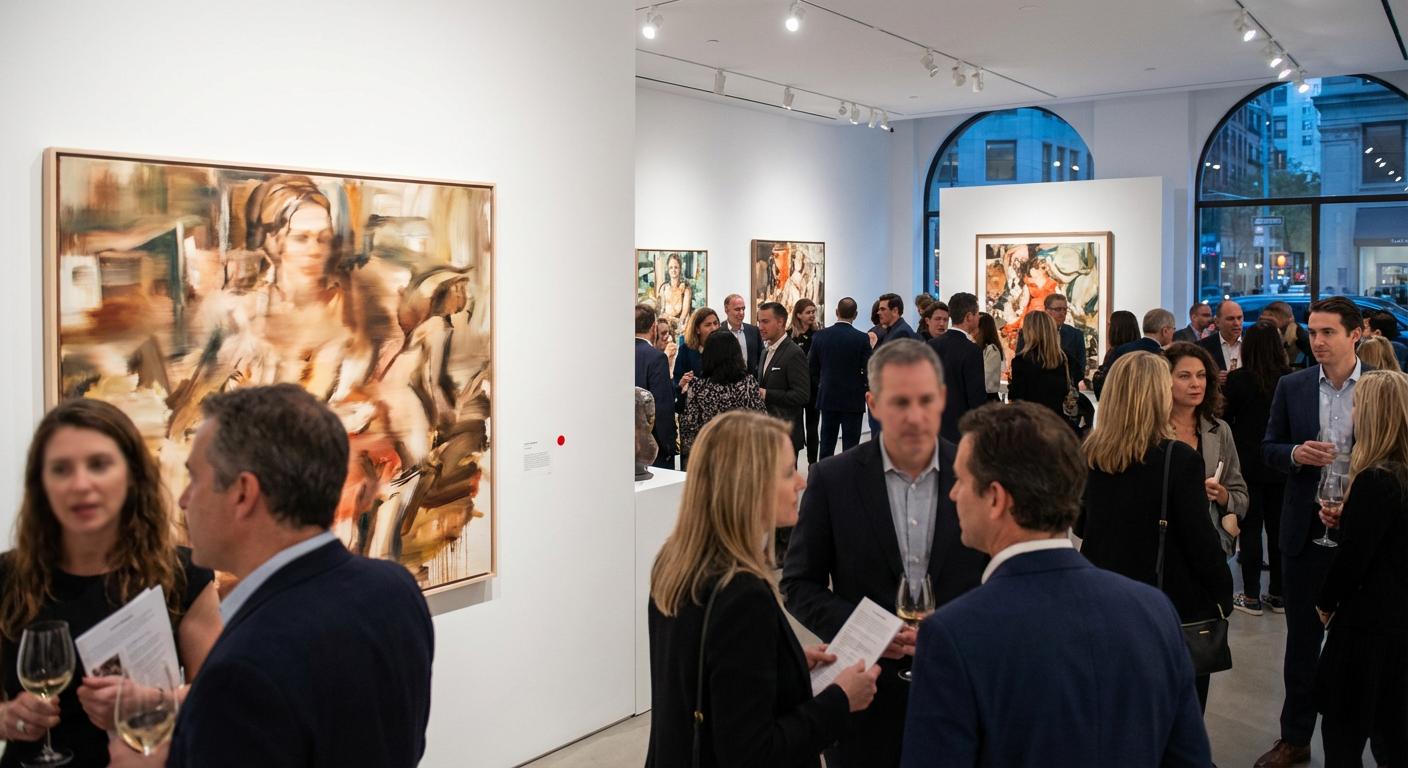
The numbers tell a story worth examining closely. At Frieze Art Fair this year, representational oil paintings from emerging artists working in what critics have begun calling “slow painting” accounted for forty-one percent of sales at mid-tier galleries. That figure is not incidental. That is a market signal so loud it has already spawned think pieces, panel discussions, and the kind of institutional legitimacy that usually takes a decade to accumulate. These are hyper-labor-intensive works, often representational, addressing figuration in ways that would have seemed merely conservative five years ago. Yet here we are.
The Documentation Paradox
What makes this movement particularly fascinating is not just the work itself but the surrounding apparatus of proof. Christie’s 2025 Post-War and Contemporary sales revealed something almost amusing: paintings with documented long production times, where provenance explicitly includes studio process diaries and timestamped documentation, sold at an average premium of twenty-three percent over comparable works lacking such records. This is the art market’s way of saying it wants evidence. It wants witnesses. It wants you to prove that you actually spent those eighteen months on that canvas.
This feels important because it suggests something deeper than aesthetic preference. We are in a moment where the speed of digital production, the algorithmic churn of NFT generation, and the general sense that anything can be made instantaneously has created a hunger for authentic slowness. But here is where I must push back against the convenient narrative: is the market actually rewarding artistic integrity, or is it simply rewarding the commodification of labor itself? The studio diary has become provenance. The artist’s struggle has become marketing material. We have turned the artist’s time into a tradeable asset, which is certainly something, but I am not entirely convinced it is something virtuous.
Intellectual Architecture and Institutional Blessing
The formal legitimacy came in February when the College Art Association hosted a panel discussion at its annual conference in New York explicitly examining “slow painting” as both market phenomenon and philosophical stance. Fourteen scholars presented work examining the movement’s market dimensions and theoretical underpinnings. This is institutional validation of the highest order. When the academy begins seriously theorizing a market trend, that trend has either already won or is about to become genuinely important.
What strikes me about this development is how quickly the discourse has solidified around a particular narrative: slow painting as resistance. Resistance to what, exactly? The speed of digital culture. The disposability of algorithmic art. The endless scroll. All of this is true enough, but it also feels somewhat self-satisfied, as if the very fact of temporal investment automatically confers artistic merit. I have seen plenty of slow paintings that are tedious precisely because they are slow, that mistake labor for vision. And I have seen quick works of staggering depth. Yet the market has decided that time equals quality, and here we are.
The Concrete Evidence: When Markets Actually Shift
Consider Cecily Brown’s recent exhibition at Gagosian New York. Twenty-two works sold out within forty-eight hours of the preview opening. The largest canvas, reportedly developed over eighteen months of studio work, fetched four point two million dollars. This is not marginal market activity. This is not a niche collecting trend. This is a major gallery, a major artist, a major price point, and a market moving decisively in one direction.
The broader context matters here. Artsy Intelligence reported a nineteen percent year-over-year decline in NFT art transaction volume for the third quarter of 2025, while physical painting sales in the under-five-hundred-thousand-dollar bracket grew fourteen percent in the same period. Collectors are not just buying slow painting. They are abandoning the digital entirely and returning to objects. To surfaces. To things that take up physical space and require actual presence to appreciate.
The Uncomfortable Questions We Are Not Asking
What troubles me about this moment is how cleanly it maps onto existing power structures. Slow painting requires studio space, sustained financial support, the luxury of time. It is, almost by definition, a movement available primarily to artists who already have resources. The young artist working a service job cannot afford to spend three hundred hours on a single canvas. The market for slow painting is, in many ways, a market for inherited or accumulated privilege dressed up in the language of authenticity and artistic integrity.
This does not mean the work itself is without merit. But it means we should be suspicious of narratives that celebrate temporal investment as inherently valuable without examining who can actually afford to invest that time. The market loves a story about artistic dedication, particularly when that dedication can be monetized and packaged as philosophical resistance to digital culture.
So here is where I land: slow painting is genuinely interesting as a symptom of our moment. It tells us something true about contemporary hunger for slowness, for objects, for time-based value. But the reasons we should pay attention are not necessarily the reasons the market is paying attention. The market wants proof of labor because proof of labor justifies premium pricing. We should want to understand slow painting because it raises genuine questions about attention, craft, and what we believe art is for. Those are not the same thing, and conflating them feels like exactly the kind of lazy consensus thinking I have no patience for.
What remains to be seen is whether this market momentum will produce genuinely sustaining artistic practices or simply create another extractive cycle where collectors accumulate certificates of cultural sophistication. The work that emerges over the next two years will tell us which version of this movement actually matters.