The Album as Auteur Provocation
There is a particular kind of artistic arrogance required to spend fifteen million dollars on the visual components of an album. Not a film. Not a Netflix limited series. Not a concert film with theatrical distribution. An album. The Cowboy Carter project arrived in March 2024 with a deliberate refusal to occupy any single medium, which is precisely what makes it the most significant artistic statement about the current state of creative production we’ve seen in years. Beyoncé did not make a music album with visual accompaniment. She made a multimedia text that happens to contain songs, and the distinction matters.
What we are witnessing is not new in spirit, though the scale and commercial viability are genuinely novel. The genealogy runs backwards through Kendrick Lamar’s Mr. Morale and the Big Steppers rollout, through the Childish Gambino era of video-as-album-component, back through the MTV visual album moment of the early 2000s, even further back to Prince’s multimedia ambitions in the 1980s. But none of those predecessors pulled off the kind of tight integration that Cowboy Carter achieved. This was not a music video series. It was a cinematic narrative infrastructure built to support sonic architecture, with neither element subordinate to the other.

The Numbers That Prove the Paradigm Shift
Within seventy-two hours of release, the visual components accumulated over ninety million views across streaming platforms. That is not exceptional for contemporary media. What is exceptional is the demographic it pulled and the cultural door it opened. According to the Spotify Loud & Clear 2025 Report, the album triggered a twenty-one percent increase in country music streaming among Black listeners. This is not a minor fluctuation. This is a documented genre redefinition moment. Beyoncé did not simply enter country music discourse; she altered the entire listening population’s relationship to a genre that had systematically excluded Black artists from its institutional apparatus.
The Recording Academy responded with immediate structural shifts. According to Recording Academy 2025 Grammy Submissions Data, country category submissions increased by thirty-four percent for the 2025 Grammy Awards cycle. Industry observers directly attributed this surge to the Cowboy Carter moment. Translation: an artist released a multimedia project so culturally significant it fundamentally altered the demographics and institutional participation of an entire music genre within months. That is not a minor cultural event. That is a remake of institutional infrastructure through artistic work.
The Visual Production as Auteur Statement
Harvard cultural analysts took notice. The institution’s 2025 analysis positioned Cowboy Carter as a case study in what they termed “multimedia auteurism,” a framework that treats visual production and sonic composition as inseparable elements of authorial vision. The comparison point they selected was revealing: a mid-budget feature film. The visual production cost approximately fifteen million dollars. Think about what that scale means. Major independent films operate in that budget range. Prestige television seasons operate in those parameters. Yet this was allocated to accompany an album, which suggests a fundamental recalibration of how the music industry now invests in artistic credibility and cultural impact.
The merchandise collaboration with Nigerian-American designer Kenneth Ize crystallized this auteur positioning into commercial reality. The collection sold out in eleven minutes when it dropped in February 2025. Eleven minutes. This was not merchandise as afterthought or secondary revenue stream. It was visual art as an extension of the album’s conceptual apparatus, designed with the same intention as the film sequences and the sonic material. The velocity of the sellout indicated that audiences understood the entire Cowboy Carter ecosystem as a unified creative statement, not as an album with optional accompanying materials.
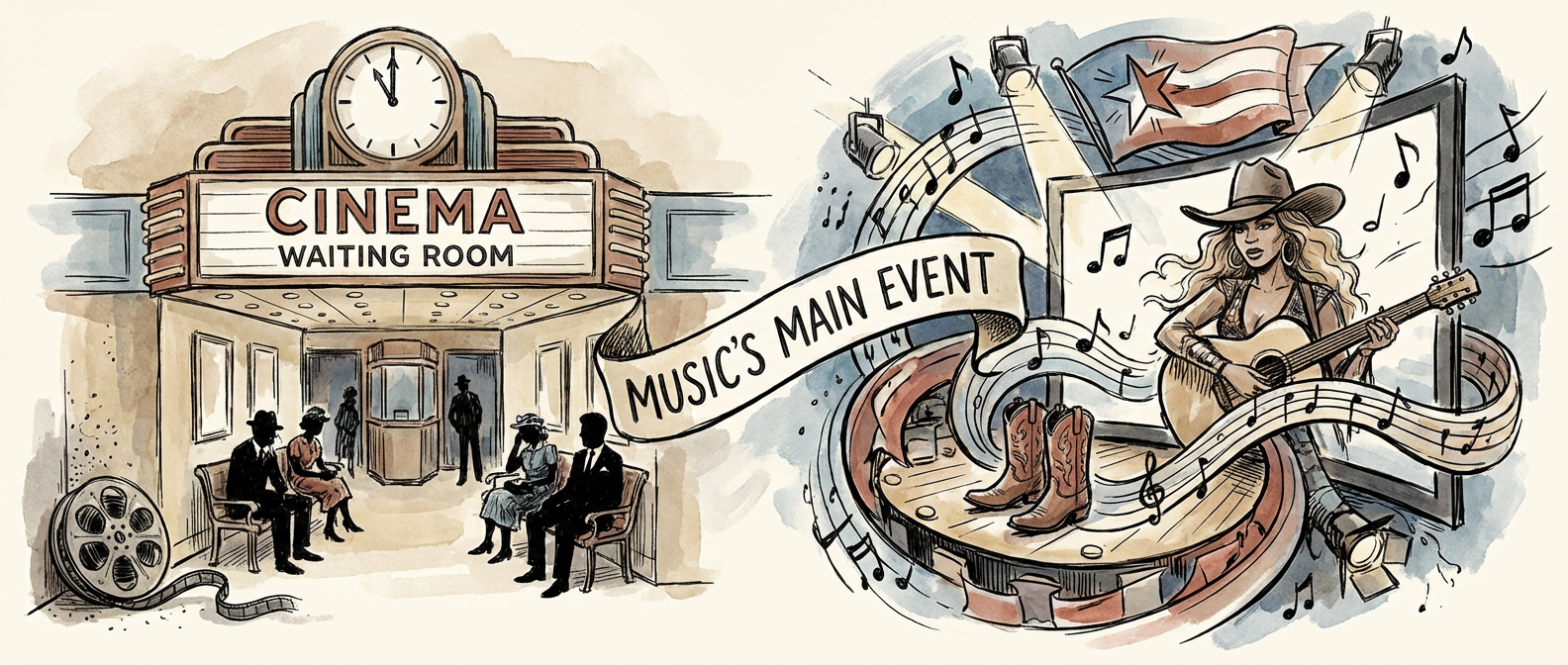
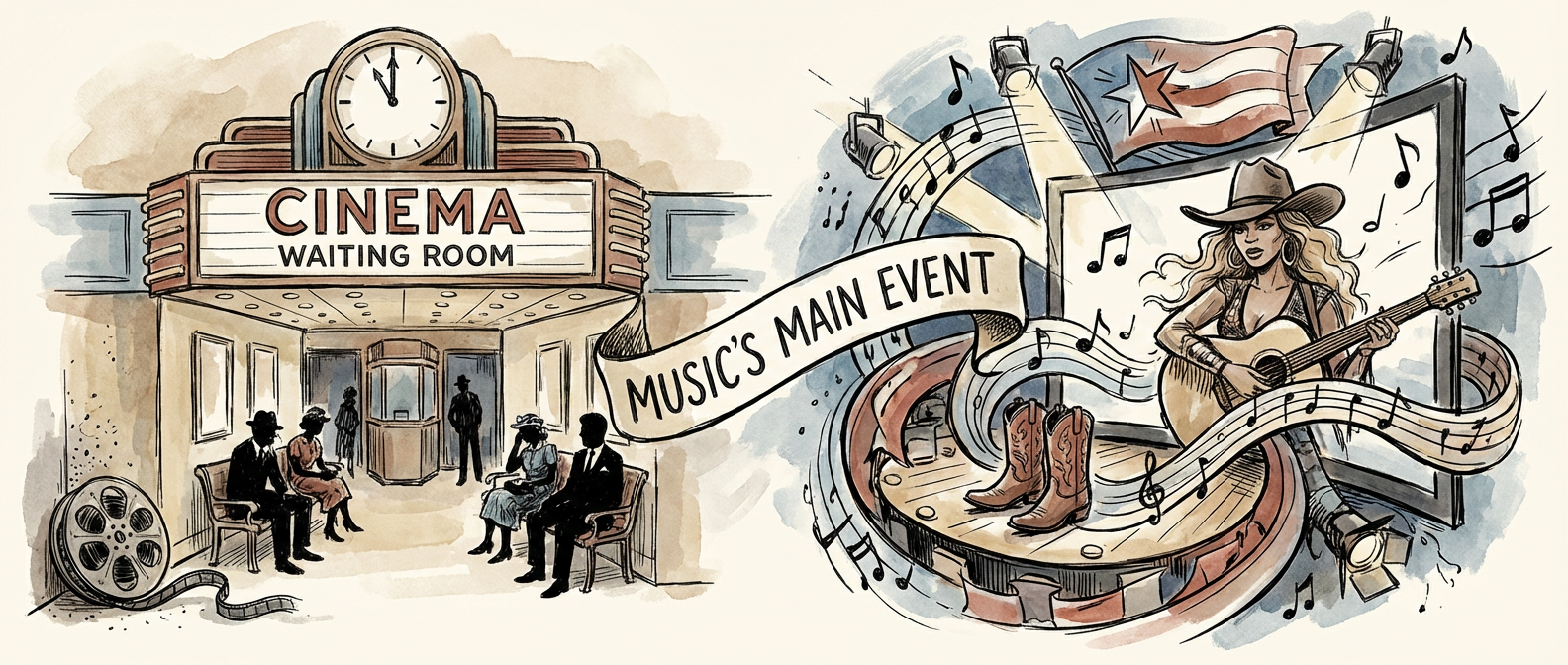
Cinema Is Now the Waiting Room for Music’s Actual Ambitions
What Cowboy Carter reveals is that cinema, as a discrete medium with its own institutional frameworks and exhibition traditions, has become something else entirely in the contemporary moment. It has become the formal language that music deploys when it wants to say something complex. The film industry still operates as though cinema exists in a separate ontological category from recorded music, but the artists who command the most cultural attention have stopped accepting that distinction. They treat cinema as a tool set, not a destination.
This represents a genuine inversion of the twentieth-century media hierarchy. For decades, a musician who wanted to achieve legitimacy would make a film or a theatrical production. Now, a musician who wants to deploy cinema does so in service of a musical vision. The film is the supporting argument, not the primary text. The album is the statement, and cinema is one of several languages in which that statement is articulated. Beyoncé did not compromise her artistic vision to accommodate film conventions or television pacing. She built visual language that served sonic architecture, not the other way around.
What This Means for the Future of Form
The institutional implications are still unfolding. We are living through a moment in which the traditional separations between creative disciplines are collapsing from the ground up, driven by artists who have the cultural capital and commercial freedom to refuse inherited categorical frameworks. Cowboy Carter is not the first project to operate this way, but it may be the one that finally forces the critical establishment to acknowledge that this is not a temporary experiment or a gimmick. This is how significant artistic work happens now.
The real question for the next phase is whether this multimedia auteurism stays exclusive to artists with Beyoncé’s particular kind of cultural and financial leverage, or whether it becomes the operational norm across genres and scales. What seems clear is that cinema will never occupy the same position of prestige it held before artists started treating it as one tool among many rather than the apex form of artistic expression. The hierarchy has flipped. The medium once considered the ultimate achievement has become, quite simply, one more language in which artists choose to speak. How the institutions that organized themselves around cinema’s dominance will adapt remains genuinely uncertain. That uncertainty itself is the interesting part.
What do you think cinema’s role should be in this multimedia moment? Does the integration of music, visual art, fashion, and film into single unified statements represent artistic freedom, or does something get lost when traditional media boundaries dissolve? I’d genuinely like to hear your thoughts on how you experienced Cowboy Carter, and whether the multimedia approach deepened or complicated your engagement with the actual music.