The Underpaint Revelation That Changes Everything
Walk into any conversation about Vermeer and someone will inevitably invoke the word “luminous” as though it explains something. They’ll mention the pearl earring catching light like it’s the entire point, and you’ll nod politely while internally screaming because nobody actually understands how he did it. Well, that conversation just got a lot more complicated.
The Getty Conservation Institute’s 2024-2025 analysis of “Girl with a Pearl Earring” using multispectral imaging technology has exposed something that conventional X-ray radiography spent centuries missing: three distinct underpaint layers working in concert beneath the visible surface. Three. This isn’t a minor technical detail for conservators to file away. It fundamentally reframes how Vermeer constructed luminosity itself. He wasn’t painting light onto canvas. He was building it from underneath, layer upon layer, using a methodology so intentional and sophisticated that it reads almost like advanced computational design executed by hand in the 1660s.
What makes this discovery genuinely unsettling is the implication. Every reproduction, every museum poster, every cheap print you’ve ever seen of his work shows you roughly sixty percent of what’s actually happening. The visible painting is the final statement, but the real conversation is happening in those buried layers where Vermeer was essentially conducting experiments in light transmission through pigment. The Getty’s findings suggest he understood something about how human vision processes color and luminance that wouldn’t be formally articulated in optical science for another two centuries.
The Camera Obscura Question Finally Has Teeth
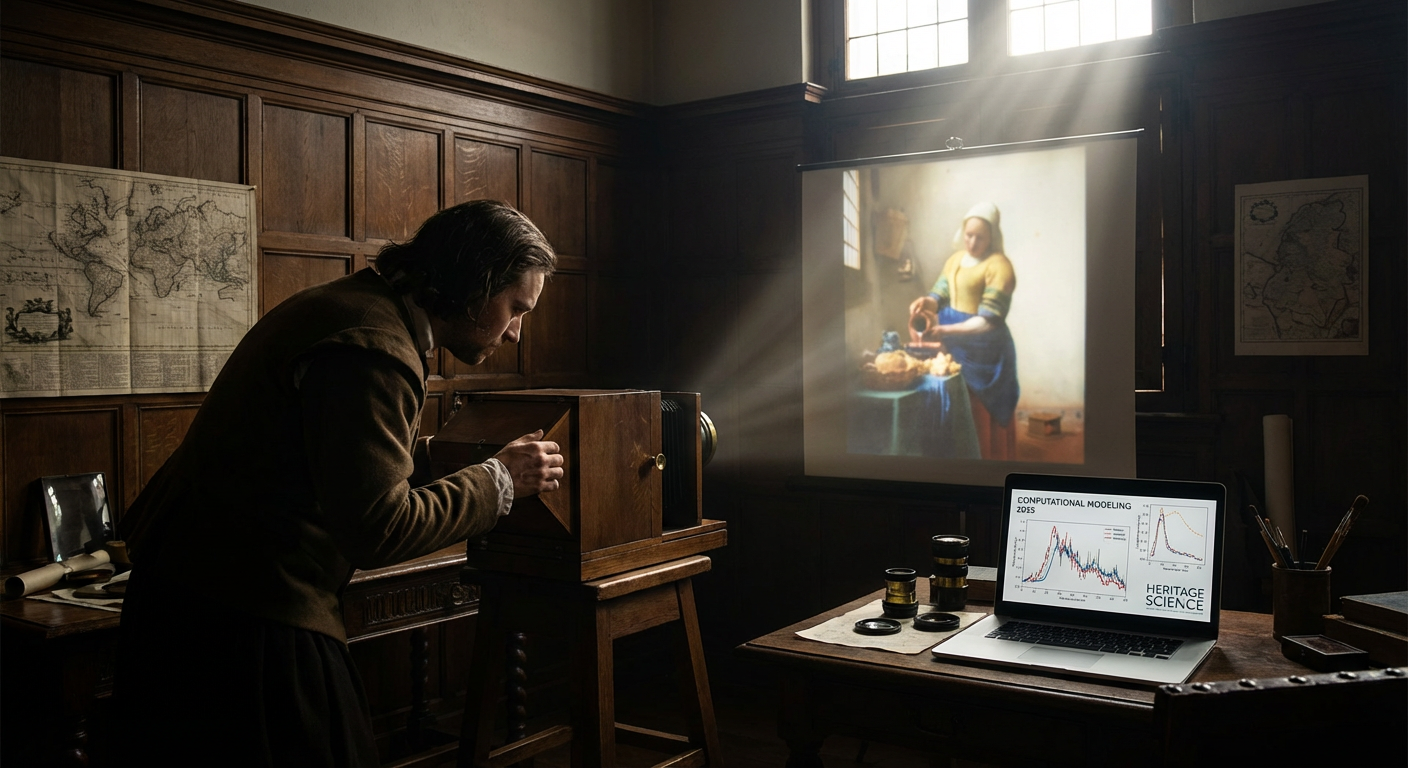
The camera obscura debate has lived in a frustrating limbo for decades. Art historians squabble about whether Vermeer used one, citing optical precision and tonal subtlety as evidence, while skeptics counter that it’s reductive and diminishes his genius. Both sides have been arguing with insufficient data. That changed in 2025 when computational modeling published in Heritage Science examined the mathematics of Vermeer’s spatial perspective, light behavior, and focal point placement across twenty of his documented works.
The modeling doesn’t prove he used a camera obscura, but it makes the hypothesis dramatically more plausible. When you overlay the optical properties of a camera obscura’s lens with the actual spatial relationships Vermeer rendered on canvas, the correlations are too precise to dismiss as coincidence. He wasn’t tracing reality directly, but he appears to have been using optical principles to calibrate how light and shadow should behave in his compositions. This is the difference between someone who got lucky and someone who engineered their results.
What’s radical about accepting this is that it doesn’t diminish Vermeer at all. It redefines what we mean by genius. He wasn’t painting from observation alone. He was translating optical phenomena into paint, which requires a completely different intellectual apparatus. He was an engineer working in pigment, solving problems about light representation that most of his contemporaries weren’t even asking. That’s arguably more impressive than if he’d simply painted what he saw.
The Data Infrastructure That’s Opening Everything Up
Behind all these discoveries is something less glamorous but potentially more important: infrastructure. The Getty Conservation Institute launched an open-access database in late 2024 containing over twelve thousand high-resolution pigment maps from Dutch Golden Age paintings. This isn’t just an archive. It’s a fundamental democratization of art historical knowledge that should be making traditional museum gatekeepers slightly nervous. Anyone with internet access can now examine the molecular composition of paintings in ways that were previously restricted to credentialed researchers with institutional access.
The database includes comparative materials from the Getty Conservation Institute Research teams, which means you can track patterns across entire bodies of work. You can see how artists sourced materials. You can identify workshops and suppliers. Researchers at the University of Amsterdam have already exploited this by identifying a specific lead white compound used in Vermeer’s work that traces back to a documented Amsterdam supplier mentioned in seventeenth-century guild records. They’re literally establishing supply chains for paint.
This matters because future discoveries won’t depend on individual conservators stumbling onto anomalies. Pattern recognition across thousands of paintings accelerates understanding. The database essentially turned art history into something closer to data science, and the implications haven’t fully registered yet.
The Mauritshuis Effect and What It Means for How We Experience Art
The Mauritshuis Museum in The Hague reported over six hundred fifty thousand visitors in 2024, breaking their attendance records after expanding their Vermeer digital interpretation gallery. Let that number sit for a moment. They essentially doubled their annual visitor count by offering people new ways to understand what they were looking at. This is the opposite of what institutional gatekeepers usually assume. They think people want mystery and reverence. Turns out people want to understand.
The digital gallery offers multispectral imaging comparisons, underpaint reconstructions, and pigment analysis presented in ways that don’t require a PhD in conservation science to engage with. You can see the layers. You can follow the construction process. You can understand the choices. The Mauritshuis Vermeer Collection became more valuable once people understood how it was made.
This is the cultural moment we’re living through. Transparency about process doesn’t diminish art. It deepens it. Museums that hide their technical knowledge behind conservation reports nobody reads are operating from a scarcity mindset. Museums that share that knowledge are building actual engagement. The Mauritshuis proved it empirically.
What This Means for How We Read Art Going Forward
The Getty’s 2025 project hasn’t finished rewriting our understanding of Vermeer. It’s confirmed that our previous understanding was incomplete. We were reading the surface. We were missing the architecture.
What happens when we apply this same analytical apparatus to other painters? What hidden infrastructure exists beneath Rembrandt? What did Caravaggio know about light that we haven’t yet discovered because we were looking at the wrong layer? The technology and methodology are portable. The database is expandable. The questions are scalable.
We’re not celebrating the conclusion of a debate. We’re watching the establishment of a framework that will make previous debates seem quaint. This is how knowledge advances when institutional resources align with genuine curiosity. The dinner party conversation just got a lot more interesting.